
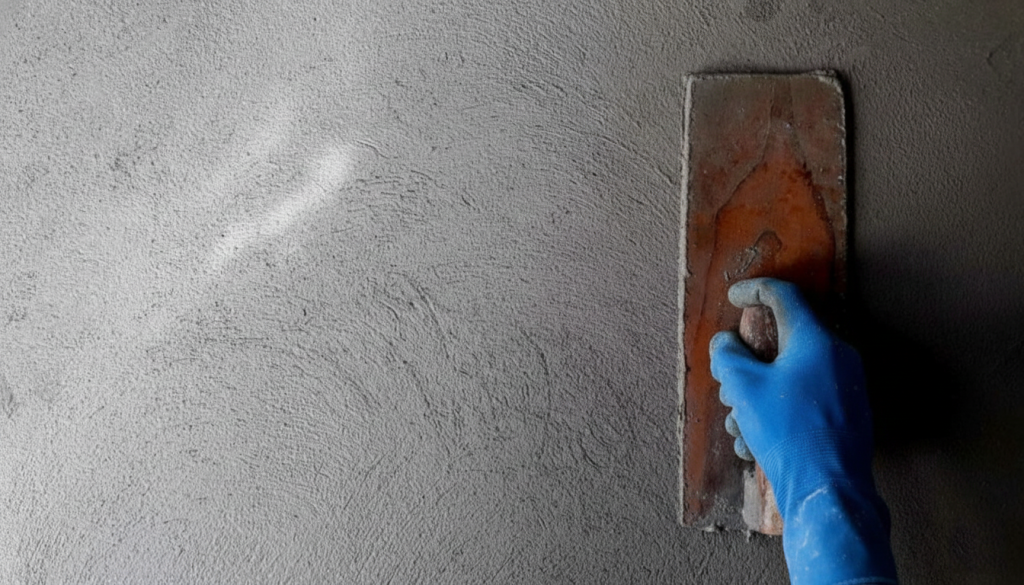
Ready Mix Plaster
Ready mix plaster is a premixed sand‑cement plaster enhanced with polymers and graded sand, designed to give faster application, smoother finishes, and more consistent quality than site‑mixed plaster. It is supplied as a dry powder; masons only need to add water and mix to get a uniform, ready‑to‑use plaster.
Key features
High strength and long‑term durability with good crack resistance.
Excellent water retention, which improves curing and bond with the substrate.
High coverage and economical consumption due to optimized mix design and graded sand.
Faster application because no batching, sieving, or proportioning is needed on site.
Compact plaster matrix that reduces void gaps and improves surface density.
High workability, allowing smoother spreading and easier trowelling.
Suitable for a variety of substrates when applied with correct preparation.
Uses clean, graded sand with no site contaminants, reducing defects and rework.
Lower rebound loss on vertical surfaces, especially during spray or trowel application.
Supplied premixed; only clean water has to be added, minimizing human error.
Importance of ready mix plaster
Ready mix plaster simplifies masonry and plastering work by eliminating on‑site mixing variability, which often causes weak, uneven, or cracked surfaces. Because the proportions of cement, sand, and additives are controlled at the plant, the mason gets consistent quality in every bag, leading to uniform strength and finish across the project.
Polymer modification and silt‑free graded sand help the plaster bond strongly to the substrate while creating smooth, level surfaces with minimal undulations. Reduced curing requirements, better hydration retention, and lower re‑bonding losses mean less water usage, fewer touch‑ups, and shorter project timelines.
Produced using modern technology and aligned with relevant standards (such as IS 1542 for cement plasters), quality ready mix plasters offer superior coverage, quicker setting, and more durable, aesthetically pleasing finishes compared to conventional, manually mixed sand‑cement plasters.
Technical Data
|
PROPERTY
|
TEST METHOD
|
SPECIFICATION
|
|
Setting Time: Initial
|
IS:4031 (Part-5): 1988
|
>=100 min
|
|
Setting Time: Final
|
IS:4031 (Part-5): 1988
|
<=180 min
|
|
Pull off Adhesion
|
EN 1015-12
|
Min 0.3 Mpa
|
|
Compression Strength (28days)
|
EN 1015:11:1999
|
As per EN 998-1 for categories (N/MM2) CSIV->6/mm2
|
|
Flexural Strength (28days)
|
EN 1015:11:1999
|
Min 1.8 Mpa
|
|
Water Retentivity
|
EN 1015-8
|
Min 95%
|
|
Capillary Water Absorption
|
EN 1015-18
|
As per EN 998-1
W2 C <=0.20kg/m2.min0.5
|
|
Bulk Density Kg/m3
|
In House
|
1500-1700
|
|
Water Demand %
|
IS-4031 (A)1988
|
25% max
|
Build well Ready -mix plaster ‘s approximately average per 40 kg is as under
Buildwell Ready‑Mix Plaster offers predictable coverage per 40 kg bag, helping plan material requirements more accurately for different substrates. Coverage figures are indicative and will vary based on surface evenness, porosity, and workmanship.
Coverage per 40 kg bag
10–12 mm thickness on lightweight blocks: 17–18 sq.ft.
10–12 mm thickness on brick wall: 14–15 sq.ft.
18 mm thickness on lightweight blocks: ≈11 sq.ft.
25 mm thickness on brick wall: 7–7.5 sq.ft.
10 mm thickness on RCC: 20–22 sq.ft.
For best performance and to avoid shrinkage or cracking, plaster layers thicker than 10–12 mm should always be applied in two coats rather than a single thick coat.
COMPARISON
|
TRADITIONAL PLASTERING
|
READY MIX PLASTER
|
|
• Cement + Sand to be mixed differently
|
• Cement + Sand all in one bag
|
|
• Need to add Admixtures seperately
|
• Admixtures already added in the bag
|
|
• Complex Method
|
• Very Easy to Use
|
|
• Crack Issue
|
• No Crack Issues
|
|
• Slow Workability
|
• Faster Workability
|
|
• Less Coverage per Square Feet
|
• Better Coverage – 20 Square feet
|
|
• Costlier
|
• Cost Effective
|
|
• Approx Cost –> 100 sq ft –> Rs 1105/-
|
• Approx Cost –> 100 sq ft –> Rs 1036/-
|
|
• No Cement Control
|
• Cement Control
|
|
• More Wastage of Materials
|
• Very Less More Wastage of Materials
|
|
• More Labour Cost
|
• Very Less Labour Cost
|
|
• Less Finishing
|
• Better Finishing
|
For ready reference refer to the link below.